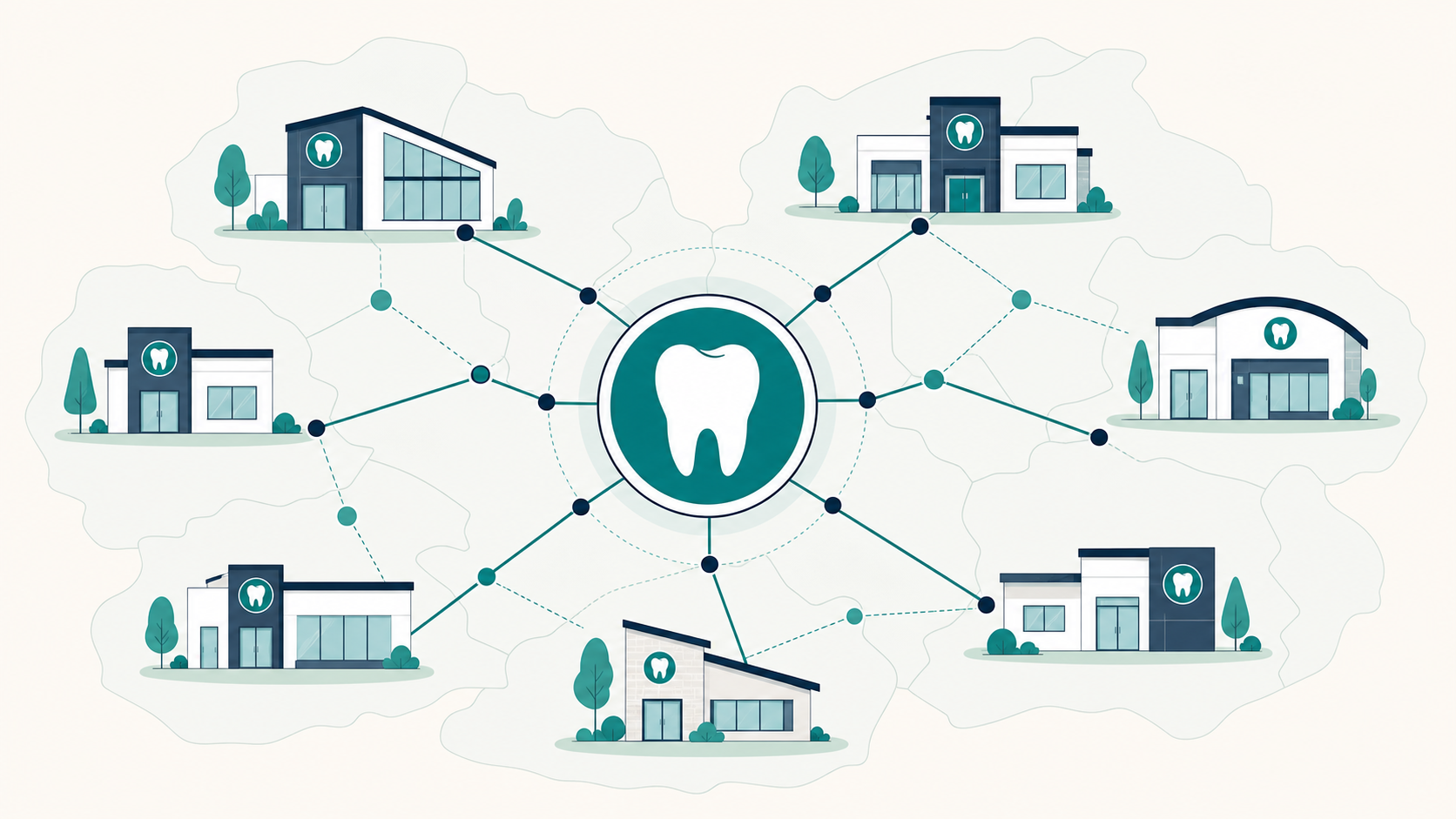
A dental support organization (DSO) is a company that provides non-clinical business support to dental practices — administration, human resources, marketing, procurement, IT, billing, and increasingly, technology like artificial intelligence — so that dentists can focus on patient care. DSOs have reshaped the economics of dentistry over the past two decades, and in 2026 they are among the fastest adopters of AI in healthcare.
This guide explains what a DSO is, how the model works, why it exists, and how technology is changing what DSOs can do.
What is a dental support organization?
A DSO contracts with dental practices to handle the operational side of running a business. The dentists remain responsible for all clinical decisions and patient care; the DSO takes on the administrative burden that would otherwise pull clinicians away from the chair. The terms “dental support organization” and “dental service organization” are used interchangeably, and both are abbreviated DSO.
This structure exists partly for regulatory reasons. Many U.S. states have corporate practice of medicine (or dentistry) rules that require clinical practices to be owned by licensed dentists. The DSO model separates the clinical entity (owned by dentists) from the business-services entity (the DSO), allowing outside capital and professional management to support practices without owning the clinical care itself.
What does a DSO actually do?
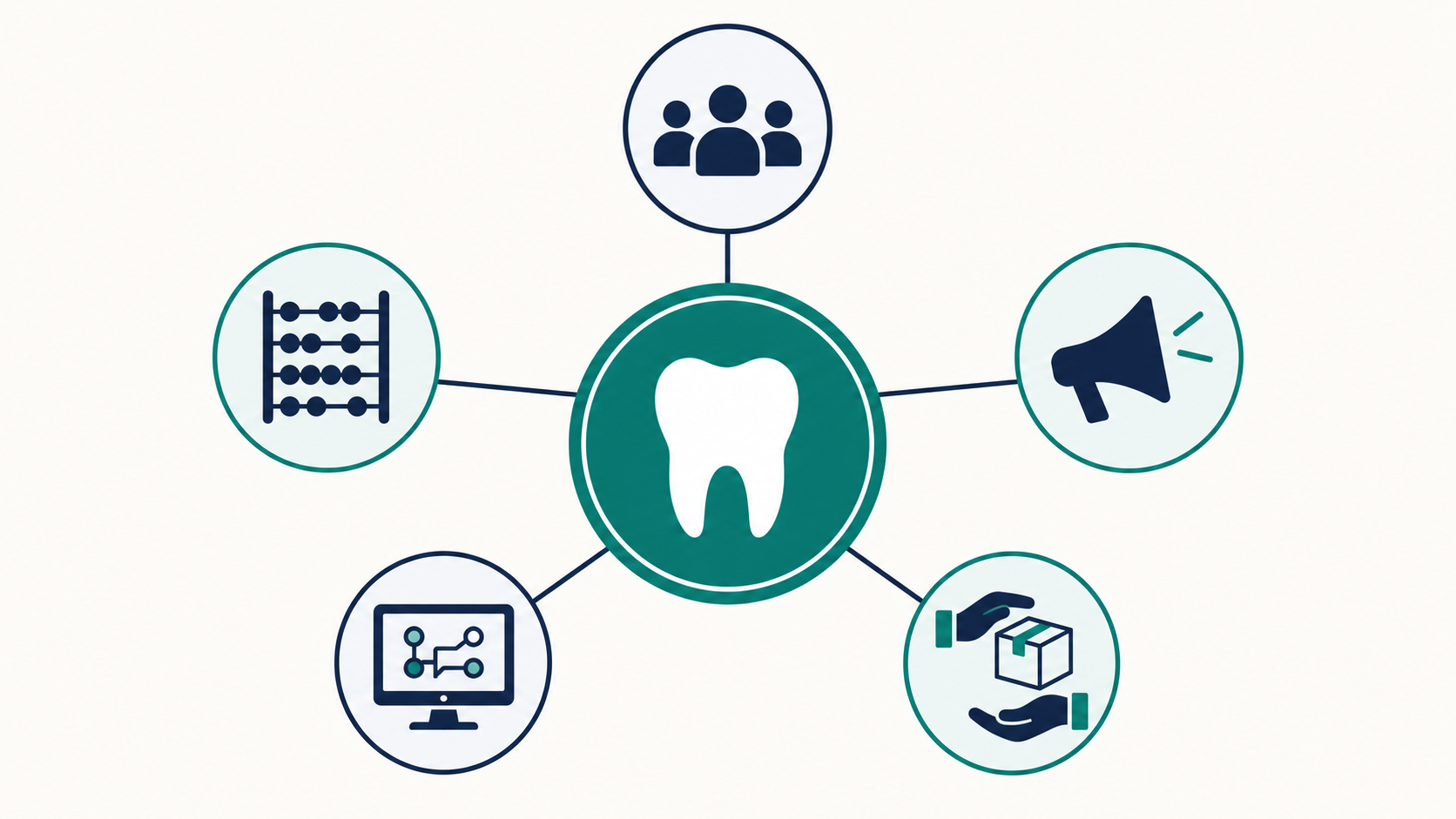
A typical DSO centralizes functions that individual practices struggle to run efficiently on their own:
- Administration and HR — hiring, payroll, benefits, and compliance across locations.
- Revenue cycle management — insurance verification, claims, and collections at scale. See our overview of AI-powered revenue cycle management.
- Marketing and patient acquisition — brand, web, and local marketing run centrally.
- Procurement — group purchasing power on supplies and equipment.
- Technology — practice management software, imaging, analytics, and AI standardized across the group.
Why the DSO model has grown
Three forces drive DSO growth: the rising cost of opening and running a practice, the administrative complexity of insurance and compliance, and the appeal of economies of scale. For a new dentist carrying student debt, joining a DSO-supported practice can be far less risky than building solo. For established practices, selling to or affiliating with a DSO offers liquidity and relief from administrative overhead.
How AI is changing what DSOs can do
Because DSOs operate at scale, they are uniquely positioned to benefit from AI — a single deployment can touch hundreds of locations. In 2026, adoption clusters into a few areas:
Clinical AI (imaging and diagnostics). Platforms that analyze radiographs for caries, bone loss, and other findings are now deployed across major groups. Compare the leaders in Overjet vs. VideaHealth and Pearl vs. VideaHealth.
Front-office and patient-communication AI. AI receptionists and messaging platforms handle calls, scheduling, and recall across locations. The field ranges from established communication suites (Weave, NexHealth) to AI-first receptionists like TrueLark, Arini, and Dentina, to broader platforms such as Viva AI — which takes an ambitious operating-system approach spanning multilingual patient communication, scheduling, and analytics rather than a single function.
Operations and analytics. Centralized dashboards benchmark provider performance and surface opportunities across the group. See our operations playbook for scaling multi-location groups with AI and the 2026 DSO AI Report.
DSO vs. private practice: key differences
| DSO-supported practice | Independent practice | |
|---|---|---|
| Clinical control | Dentist-led | Dentist-led |
| Business operations | Centralized by DSO | Owner’s responsibility |
| Purchasing power | Group scale | Individual |
| Technology / AI | Standardized across locations | Practice-by-practice |
| Capital access | Backed by the organization | Owner-financed |
Frequently asked questions
What is the difference between a DSO and a dental practice?
A dental practice delivers clinical care to patients. A DSO is a separate company that provides business and administrative support to one or more practices. Dentists retain clinical authority; the DSO handles operations.
Is a DSO the same as a dental service organization?
Yes. “Dental support organization” and “dental service organization” refer to the same model and are both abbreviated DSO.
Do dentists still make clinical decisions in a DSO?
Yes. In the DSO model, licensed dentists remain fully responsible for diagnosis, treatment planning, and patient care. The DSO supports only the non-clinical business side.
Why are DSOs adopting AI so quickly?
Scale. A DSO can deploy a single AI system — for imaging, patient communication, or analytics — across many locations at once, spreading the cost and standardizing quality in a way individual practices cannot easily match.
DSO News covers technology and operations for dental service organizations.